Welcome
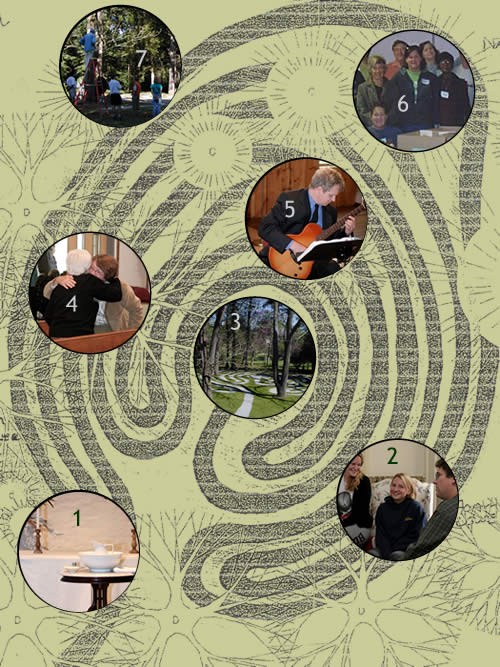
- 1. Worshipping
- 2. Questioning and growing
- 3. Finding the center
- 4. Sharing and affirming
- 5. Performing
- 6. Serving
- 7. Getting involved
Welcome to the Internet version of Church of the Loving Shepherd…although visiting Loving Shepherd this way is as much like the real thing as looking at a photo of an airplane is like flying. While we are thankful for the Internet and this opportunity to show and tell you all that words and photographs can convey about this extraordinary church on 21 pastoral acres in Chester County, it’s no substitute for the in-person experience. In person, we can get to know each other, a gift for both of us. In person, you will find nurture for your heart and your mind. We hope that, after you’ve toured this web site, you will come tour the real thing (and be sure to walk our labyrinth—a beautiful tool for meditation) and share in a few worship services with us. Everyone is welcome here.
In person is the only way you can experience one of the most extraordinary aspects of Church of the Loving Shepherd: the sense of spiritual presence as real and palpable as the majestic walnut trees and the ancient stones of the barn. You will tour lovingshepherd.org with only your eyesight, while the in-person experience of this church and its setting, Bournelyf (born-uh-leef), will stir all of your senses, including your “sixth” one, that “supposed intuitive faculty giving awareness not explicable in terms of normal perception” (Oxford American Dictionary). The church and its setting have been called “a thin place”—a place where the separation between the physical and the spiritual, the seen and the unseen, is very fine. At one point, the property was named “Dwita”—a Tamil word meaning the unseen through the seen.
Many members have come to Loving Shepherd after being disillusioned by other churches or religious organizations. The very good news is that at Church of the Loving Shepherd acceptance and understanding are part of the air we breathe. We affirm the central place of worship in our lives, and the importance of Christian sacraments, scriptures and traditions. But, like many community churches, we choose to remain independent of dogma or creed, and we respect each individual’s religious or even non-religious viewpoint. We acknowledge that each of us is in a different place on our spiritual journey, and that our mission is to support each other wherever we are. Only in the midst of such acceptance can we heal and flourish and become fully who we were born to be.
We have one Sunday service that begins at 10:00 a.m. We are an ecumenical congregation. Elements of our worship derive from various traditions including the Moravian church (the extraordinary music) and Quakerism (the silences). Worship is at the heart of our church, and prayer is at the heart of our worship. Some of the finest musicians in the Delaware Valley are frequent guests at Loving Shepherd, and the music in any given Sunday morning service is never less than glorious. Our pastor, John Woodcock, and a variety of guests, provide sermons and prayers that nurture members’ hearts and minds in different and equally effective ways. I particularly value our pastors’ ability to make Christianity’s historical and multicultural contexts relevant to today’s world, without ever suggesting that there is one right way to view it all.
From September through May, the Sunday Schoolhouse offers our younger members (grades K through 5) biblical stories in an open-ended way, providing images and language to support later, more mature conversations. They are invited to explore their own questions and insights. By middle school youth are exposed to both traditions and to examples of people of faith, which allow them to further their own understandings. High school aged youth focus on subjects as wide ranging as their own interests. Programs for adults are more topical, and as disparate as The Shawshank Redemption and the writings of Etty Hillesum.
Wednesdays members gather at 11:00 a.m. for a half hour of prayer. Friends on the Journey meets in the church house parlor at 7:15 Thursday evenings. Friends began when a member expressed a desire for a group of adults who would meet and talk freely about spiritual topics and their spiritual journeys. Over the years FOTJ has evolved into one of the loveliest gifts Church of Loving Shepherd offers. The sharing at the Friends’ gatherings is enlightening and always encouraging.
If you have any questions that we haven’t covered in this letter, please feel free to call the church office at 610-692-8280, or contact the office through email here.
Bishop John Shelby Spong, author of A New Christianity for a New World, has said, “I think the only task facing the Christian Church in our day is to enhance the humanity of every person, so that living fully, loving wastefully and daring to be all that they can be, they make visible all that the human word ‘God’ means.” In that light, Church of the Loving Shepherd beautifully fulfills its task.
Worship
Common worship at Church of the Loving Shepherd is the heart of our congregation’s life and work. The late Alexander Schmemann, professor at St. Vlaldimir’s Theological Seminary, once commented that when we start out the door to join with others for worship, we are starting to build the Church. Likewise, we believe that each member’s daily spiritual life contributes to building our worship together on Sundays and holy days. Worship begins when the first worshipper enters and is seated quietly (though some tell us their worship experience begins when they enter the grounds).
Each Sunday at 10:00 a.m. we gather in “The Barn Chapel” (or occasionally on the grounds) to worship in an order rooted in formal traditions, but in a fashion relaxed enough to accommodate members whose root traditions are less structured. You might understand our worship easily if you realize that the first half of the service is about our listening for God—in silence, music, scripture and sermon—while the second half of our service is our response to God—through our affirmation of faith, our prayers, offerings, sacraments and a blessing. And if you are familiar with the Roman Mass, the Episcopalian Book of Common Prayer, the Lutheran Book of Worship, or even a “high Scots” Presbyterian service, you would find elements familiar to you.
In addition to worship on Sunday mornings, we observe many holy days. Specific times of worship for those days can be found on our web calendar. We follow both the liturgical year—Advent, Christmas, Epiphany, Lent, Holy Week, Easter, Ascension, Pentecost and Trinity, and the “Common Lectionary”—the three year cycle of readings from Scripture shared by many denominations.
For a true feeling of worship here, there’s nothing like a visit. And while you will be warmly greeted, we don’t indulge in “arm-twisting.”
Questioning and growing
Faith education provides tools for growth to spiritual maturity. As a community church located within the Christian family, Loving Shepherd honors the basics common to many Christian traditions. From September through May, the Sunday Schoolhouse, our one room Church School, offers our younger members (age 5 [or 4 with an adult] through grade 6) biblical stories in an open-ended way, providing images and language to support later, more mature conversations. They are invited to explore their own questions and insights. By middle school youth are exposed to both traditions and to examples of people of faith, which allow them to further their own understandings. High school aged youth focus on subjects as wide ranging as their own interests. Programs for adults are more topical, and as disparate as del Toro’s film, Pan’s Labyrinth and the writings of Etty Hillesum, using the topic, film or reading as a starting point for discussion and exploration.
The congregation acknowledges the Christian scriptures, including the apocrypha, as well as the early confessions of the faith as the expression of our forebears’ walk with God. And we recognize that within those we find examples against which we can “take the measure” of our own faith journeys.
Typically our youngest members begin worship with the church family, leaving part way into the service for their own lessons. Several times a year, our children and/or youth help lead our morning worship. The schedule for older youth is more flexible; they may meet during or after worship, and from time to time arrange field trips or overnights. “Adult” studies are usually scheduled by agreement of the participants.
Finding the center
Diogenes Laertius credits the 6th century BCE philosopher Thales with originating the phrase “know thyself.” That injunction is as relevant today as it was 27 centuries ago. But an old Jewish story brings another dimension to the phrase. According to the story the divine One had grown frustrated at being taken for granted and decided to remedy the situation by becoming hidden. The angel host was called in for consultation; one suggestion after another was considered and discarded. Finally, the wisest of the angelic order suggested that the divine One hide in the human heart, since humankind so rarely looked there.
Various opportunities for knowing one’s heart are offered at Church of the Loving Shepherd. An outdoor labyrinth and quiet space indoor and out are available for individual or group use. An indoor labyrinth is also available for walking several times each year. While most visitors find a quiet at Bournelyf, a small room has been created and set apart for prayer and quiet reflection. On Wednesdays a small group meets for mid-day prayers, and on Saturday mornings a “centering prayer” group meets in church house.
Retreats and workshops through the year provide a variety of aids to the process of finding one’s center. These have included a mindfulness meditation workshop, a yoga workshop, and a retreat focusing on the issues surrounding death and dying.
Finally, the core practice to which members are invited each year of setting one’s intentions supports this search. Because the Church feels each member is following his or her own path (to God and community), members are asked each year to review their intentions in three areas: their intentions for deepening their own spiritual lives, their intentions in support of the congregation, and their intentions in support of the larger community. Support of the congregation is touched on under the heading “Getting involved” and support for the larger community under the heading “Serving.”
Sharing and affirming
These words are included in the congregation’s vision statement: “to be a community…committed to encourage each member’s journey into God and community.”
While it might be assumed that a smaller congregation doesn’t face the challenges in community building experienced by some larger congregations, the Loving Shepherd family still feels the need to build into its life opportunities for sharing. Some of these are quite typical: coffee hours, pot luck suppers, and socials. (For the past several years an “open mike” following a pot luck supper has given members the chance to share musical and poetic gifts or to share brief readings which they have enjoyed.)
The congregation has also made a decision to hold only one worship service on Sundays, feeling that worship is the experience which most connects us, and that it is the best opportunity for members to see one another across the generations. A “Family Sunday” includes participation in leading worship by our younger members and time after worship for parents to connect while their children participate in a planned activity.
Various members track, and where needed, provide meals for individuals or families with members experiencing illness, and visitation is shared by the congregation’s elders as well as by the clergy.
In addition to Friends on the Journey, many members enjoy sharing in a “Book of the Month Club.” The group selects its readings by consensus and gathers to discuss not only the book, but different ways in which it connects with their lives. And from September through May Friends on the Journey gather to discuss topics in spiritual life, or life generally, or to focus on a book participants feel may strengthen or challenge them on their life journeys.
Several phrases in the congregation’s By-laws undergird this commitment to one another: “we understand with St. Paul that ‘God is for us’ and that God desires each of us to be truly human”; “With worship as the center of our common life, we discover appropriate ways of ministry to one another…”; and “members recognize that each person must encounter, face, and continuously realize her/his individual call and mission within lives that are unique and circumstances that are often unpredictable.” (from Article 2)
Performing
Ministry of Music and the Arts
To send light into the darkness of men’s hearts—such is the duty of the artist.
~ Schumann
It is not surprising that many people have first been attracted to our congregation through its unusual and superb music program. Since its beginning, Church of the Loving Shepherd has been a site for great music performed by professional and skilled amateur musicians.
Music enriches our worship. The New Century Hymnal contains a wonderful collection of old and new hymns with inclusive language. Our choir sings the first Sunday of each month as well as for special services, while guest musicians, vocal and instrumental, provide service music for other services. In addition, our psalm choir assists the singing of appointed Psalms twice a month.
Our organist, Dr. Kathleen Scheide, and our music coordinator (a professional trumpet soloist), Barbara Prugh, are key to maintaining the high quality of our music, both for services and for concerts. We hold a variety of concerts and recitals during the year, including our Chamber Music at Bournelyf series, our annual Dessert concert, and our annual Mark Wayne Bailey Memorial Concert. Realizing that young musicians need support and encouragement, we provide, as possible, recital space for student musicians.
At this writing future programs in the visual and dramatic arts are under discussion. We will continue to sponsor exhibits and presentations consistent with our vision and mission. Our ministry of music and the arts is a medium for outreach, community building, comfort and praise.. We believe that the arts are windows to the divine and that an experience of beauty can lead to reflection, insight and moments of transformation.
Serving
While we assume that serving others is an important aspect of being human, we make no assumptions about where or how someone should exercise that quality. Even as a smaller congregation, however, Church of the Loving Shepherd tries to find opportunities consistent with its identity and abilities to offer service.
One decision of the congregation has been to make space available at a fair but modest cost to non-profit social service or religious organizations with inclusive philosophies and approaches to service for meetings or retreats. In one sense this is a service of the congregation as a whole. At an individual level, though, this may mean a need for greeters or hosts, or snow or furniture movers.
Thirty-eight years ago the congregation created Bournelyf Special Camp, a program for children and youth with intellectual disabilities. The Camp’s six-week day programs run the Loving Shepherd campus from late June into early August. Through the years members have served as board members, volunteers or staff, assisting with campers, parking for the camp show, prep or costume assistants, or extra hands for particular projects. This has continued even since the Camp’s incorporation as a separate entity in 1989. Learn more about Bournelyf Special Camp.
In 1999 Loving Shepherd joined Mt. Carmel, COGIC, and Rice’s Temple, AUMP in a shared venture—a Congregational Nurse Program. In the years since its founding the nursing part of the program has been dropped (though referrals are sometimes made to various agencies when invited), but the food ministry has been expanded, with bi-monthly deliveries to over 40 families. Members have from time to time provided transportation or meals through this program, and in a “spin-off” from the program, members deliver fresh produce, dairy products, and staples to 36 families each month. Additionally, and together with members of Mt. Carmel, the congregation provides Thanksgiving and Easter baskets and also school supplies to members of the greater West Chester community.
Butterfly Garden to be created at Bournelyf
With great pleasure we look forward to the creation of a 40’ diameter butterfly garden at Bournelyf. The garden will grow from the collaboration of Church of the Loving Shepherd, Bournelyf Special Camp, and the Pennsylvania State University Cooperative Extension’s Master Gardener Program. This project is the “brainchild” of Master Gardener Apprentice Barbara Rinehart, a member of Loving Shepherd, with support from Special Project Chair Craig Rybinski, from special project chair and Master Gardener Coordinator Nancy Sakaduski, and from Master Gardener and Loving Shepherd member Tom Bare. Barbara is joined by other candidates who will assist through the creation process, as well as with the six-week educational component being prepared for Bournelyf Special Campers. Loving Shepherd will provide ground and some of the labor, and partial funding will be provided by memorial gifts given in memory of Josh Friedman, a former camper. Groundbreaking will take place on Earth Day, April 22nd. You may follow the garden’s progress by taking this link to its blog: http://chestercoextbutterfly.wordpress.com/2012/01/27/our-team/
And in a different vein, members conduct Sunday services at three local nursing homes three or four times a year. Each of these projects is coordinated by the Community Outreach committee.
Getting involved
Church of the Loving Shepherd is sometimes considered unusual because it doesn’t insist on membership. Therefore, at the most basic level, getting involved is a matter of personal initiative. “Membership” happens in two ways. Someone who worships regularly with the church family for three months or more is generally viewed as a part of the church family. An individual who worships regularly with the congregation for a nine-month period just prior to a business meeting may regester for her/his first business meeting. After the first meeting, regular worship for three months prior to the meeting is expected in order to register as a member for business. We want our work guided by the people consistently entering into the congregation’s worship and working “shoulder-to-shoulder” to carry out the congregation’s mission.
Getting involved can take on other dimensions. During each calendar year we encourage each “member” of the worshipping community to set yearly goals (agreed between her/himself and God) in three areas: individual spiritual life, support for the congregation, and support for the larger community. The first of these may include decisions about how regularly to participate in worship, how much time to spend in quiet or prayer, or how much time to spend nurturing one’s self. The second involves setting goals related to support of the congregation in prayer, financially or in kind, or by participation in volunteer activities (for example assisting with grounds care, food deliveries or helping with coffee hours; nine committees are represented on the Board of Directors, and each has volunteer opportunities). The third involves work in the larger community. In either of these last two cases we would encourage anyone to look at her/his gifts and abilities, at what s/he enjoys doing, and at what is needed. Intentions can be formed from within the mix of these things.
Our philosophy is not “more is better” in any of these areas. Becoming truly human requires balance and self-understanding, and it is our hope that those who “get involved” here will be growing into that sort of wholeness.